


7 Ways to Style Ethnic Inspired Western Outfits for Work
Last Updated: October 30, 2026
Quick Summary
Build ethnic inspired western outfits for the office with a three-piece formula: a neutral base you already own, one heritage layer, and a modern finish. Keep the print to one piece and let plain shoes, a solid bag, and minimal jewelry keep the look office-ready.
- Ask what plain basic you own that a heritage piece can sit on top of.
- Keep the print to one piece per outfit, everything else solid.
- Skip the dupatta for work because it changes the whole silhouette.
- Choose small, dense motifs over large florals for office settings.
- Buy your size, since relaxed hand-printed pieces are already cut for movement.
Table of Contents
- Start With the Basics You Already Own
- How to Style Indian Prints for Work Without Looking Costumed
- Indian Textile Office Outfit Ideas You Can Build From Your Closet
- How to Mix Prints for Work Outfits Without the Clash
- Fit, Movement, and All-Day Comfort in an Office Setting
- Fabric Choices for Every Season and Every Commute
- Build a Capsule That Earns Its Place in Your Wardrobe
- Shop the Pieces That Do the Work
- Frequently Asked Questions
Start With the Basics You Already Own
Most people treat heritage clothing as a separate wardrobe. A shelf for weddings, a drawer for festivals, and a daily rotation that never touches either.
At Noble Misfit, we built the whole brand around a simple idea we call "between two wardrobes." You should not have to choose between the clothes that carry your roots and the clothes that fit your Monday morning. The bridge is your existing basics.
Here is the shift. Instead of asking "how do I wear this kurta to work," ask "what plain thing do I already own that this heritage piece can sit on top of?" A white shirt.
The Three-Piece Formula: Neutral Base, Heritage Layer, Modern Finish
Every outfit in this guide follows one formula. Learn it and you can stop copying outfit photos.
- Neutral base: a solid shirt, cami, or trouser in white, black, navy, grey, or cream
- Heritage layer: one hand-printed or hand-woven piece, worn as the shirt, the vest, or the skirt
- Modern finish: a structured blazer, a plain belt, leather shoes, or a simple bag
Three pieces. One of them carries the craft. The other two stay quiet so the craft can speak. This is how you wear ethnic inspired western outfits without looking like you dressed for a different event.
How to Style Indian Prints for Work Without Looking Costumed
The costume problem comes from doing too much at once. A printed shirt, printed trousers, a bindi, bangles, and a dupatta reads as a theme.
Keep the Print to One Piece. That is the rule. One hand-printed garment per outfit, everything else solid.
A red Ajrakh shirt with black tailored trousers and plain loafers can read as office-ready.
A few more guardrails we would give a friend:
- Skip the dupatta for work. It changes the whole silhouette.
- Choose small, dense motifs over large florals. Buttis and geometric blocks read as texture from a distance.
- Let the print be the color. If the shirt is deep red, keep the rest black, navy, or cream.
If you want a fuller walkthrough of keeping hand-printed textiles office-appropriate, our guide on how to style hand printed textiles for work goes deeper on proportions and layering.
Indian Textile Office Outfit Ideas You Can Build From Your Closet
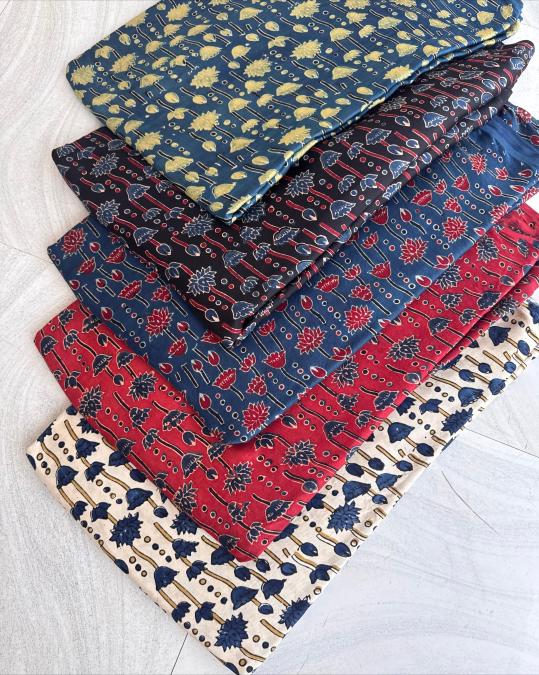
These are not shopping lists. Each formula starts with something you likely already own, and each one comes with the finishing details that make it work for a full office day: shoes, bag, jewelry, and layering.
Five Outfit Formulas to Try This Week
- The shirt swap. Take the white button-down you wear weekly and replace it with a hand-printed cotton shirt. Keep the same trousers and shoes. Nothing else changes. Finish with plain black loafers or low block heels, a structured tote in black or tan, and no necklace, let the collar and print speak. If the office runs cold, add a fine-gauge navy cardigan left unbuttoned so the print shows down the front.
- The vest layer. Wear a printed vest over a plain long-sleeve tee, with straight-leg trousers. It reads like a waistcoat, not a kurta. Add a slim leather belt in the same tone as your shoes, small stud earrings, and a crossbody bag that sits at the hip. This is the easiest formula to layer under a blazer for formal offices, choose a blazer that hits at the top of the vest so the print peeks out at the hem.
- The skirt and shirt. Tuck a plain white shirt into an A-line printed skirt. Add a belt and ankle boots. For jewelry, choose one thin gold or silver bangle and skip the necklace. A structured satchel or top-handle bag keeps the silhouette clean. In cooler months, add opaque tights in a tone that matches the skirt's darkest color, not black, so the print stays the focus.
- The open shirt. Wear a printed shirt unbuttoned over a black cami and slim trousers. This is the easiest entry point if you are nervous. Finish with pointed flats or loafers, a small pendant on a fine chain, and a slim laptop bag. The open shirt acts as a light layer, so you can remove it for a meeting and still look polished in the cami and trousers.
- The knit over. Layer a fine grey or navy knit over a printed shirt so only the collar and cuffs show. A small flash of heritage, nothing loud. Pair with tailored trousers, plain leather shoes, and a simple watch. This formula works best when the knit is a solid that picks up one color from the print, a navy knit over a print with navy motifs, for example.
Notice that four of the five keep the printed piece as the only pattern. That is not an accident. The finishing details, plain shoes, one piece of jewelry, a solid bag, are what separate an office outfit from a costume. When in doubt, remove one accessory before you leave the house.
Each formula starts with a basic you already own and adds one heritage layer plus a modern finish.
| Formula | Heritage layer | Base and finish |
|---|---|---|
| The shirt swap | Hand-printed cotton shirt | Same trousers and shoes; plain loafers or low block heels |
| The vest layer | Printed vest | Plain long-sleeve tee, straight-leg trousers, slim leather belt |
| The skirt and shirt | A-line printed skirt | Plain white shirt, belt, ankle boots, one thin bangle |
| The open shirt | Printed shirt worn unbuttoned | Black cami, slim trousers, pointed flats or loafers |
| The knit over | Printed shirt under fine grey or navy knit | Tailored trousers, plain leather shoes, simple watch |
How to Mix Prints for Work Outfits Without the Clash
Mixing prints works when the prints share a color and differ in scale. It fails when they compete on both.
The safe method: pick one large-scale print and one small-scale print in the same color family. A dense red block print with a fine black-and-cream stripe.
Three rules that keep it clean:
- Match the color, not the pattern. One color must repeat across both prints.
- Separate them with a solid. A plain belt, a solid blazer, or a solid shoe breaks the visual noise.
- Keep the rest silent. No third pattern. No statement jewelry.
If you want a focused set of print-for-work guidance before you try this at the office, our collection on how to wear prints to work covers the combinations that hold up.
Fit, Movement, and All-Day Comfort in an Office Setting
A work outfit has to survive a full day of sitting, standing, and reaching. Fit matters more than print here.
Watch out: the most common mistake is buying a relaxed hand-printed piece one size up "for comfort." It then bags at the shoulder and looks borrowed.
What to check before you commit:
- Raise both arms. The shirt should not ride up past your waistband.
- Sit down. The skirt or trouser should not pull tight across the hip.
- Check the armhole. A high, tight armhole is what makes a full day feel long.
Comfort is a design question, not a fabric slogan. A well-cut cotton piece moves with you. A poorly cut one does not, whatever the label says.
Fabric Choices for Every Season and Every Commute
Cotton is a practical choice for a commute that ends in a warm office. For practical detail on breathable Jamdani tops for daily wear, see our guide.
Match the Fabric to the Climate and the Commute
- Hot and humid: choose a lightweight cotton shirt or Jamdani skirt, and a loose cut over a fitted one.
- Rainy and damp: keep a lightweight, packable layer in your bag so you can shed a wet outer layer at the office door.
- Cool and dry: layer a printed shirt under a knit, cardigan, or blazer for heritage detail without bulk.
Fabric and the Office Dress Code
Fabric choice is also a dress-code decision. A shirt in a small print reads as business casual in most offices. For more formal environments, choose a smaller motif and a solid blazer over the top.
Build a Capsule That Earns Its Place in Your Wardrobe
A capsule here means a small set of pieces that all work with each other and with what you already own. The test is simple: can you make five outfits from three new pieces plus your basics?
Before you buy anything, run this checklist:
- Does it work with at least three things already in my closet?
- Is it solid enough to wear weekly, not just to events?
- Can I wear it to work and to dinner without changing?
If a piece fails two of these, leave it. This is how you avoid the drawer of beautiful things you never wear.
Shop the Pieces That Do the Work
The right heritage layer does most of the styling for you. You supply the basics, it supplies the character.
Our Blue Jacquard Vest ($99.00) is an easy starting point. Wear it as a co-ord with our mustard trouser, or drop it over a plain shirt with trousers you already own.
The Ajrakh Full Sleeve Shirt in Red is a bold option. Pure cotton, hand block printed, and cut to work as a work shirt or a weekend shirt.
For a skirt that moves from desk to dinner, the Jamdani A-line skirt in blue has side pockets, an elastic back, and a hem border that reads almost architectural. And if you want an easy layer to throw over neutral basics, the Ajrakh shirt in red is the one we would pick first.


Frequently Asked Questions
How can I style Indian prints for the office without looking overdressed?
Treat the printed piece as your one statement and keep everything else neutral. A hand-printed shirt with plain black trousers, or a printed A-line skirt with a white button-down, reads as polished rather than costume. Stick to structured shapes, tuck the top in, and choose closed-toe shoes. One print per outfit is the safest starting point, and it lets the craft detail carry the look instead of competing with it.
What office basics pair well with hand-printed textiles?
Plain trousers, a white or navy button-down, a fine-knit cardigan, a blazer, and a simple tank all work. Solid colors in navy, black, cream, and grey give a printed piece somewhere calm to sit. Denim works for casual Fridays. The rule is contrast in texture, not in pattern: let the hand-printed cloth be the only thing with a motif and keep the rest of the outfit quiet.
Can I wear ethnic inspired western outfits with jeans or tailored trousers to work?
Yes, and this is where these pieces earn their keep. A block-print shirt with dark straight-leg jeans and ankle boots reads as business casual in most workplaces. Swap the jeans for tailored trousers and the same shirt becomes meeting-ready. Check your office dress code first, then build the outfit around the trouser or jean you already own rather than buying something new to match.
How do I add color to office outfits without making them feel too bold?
Anchor the color with a neutral. A deep red Ajrakh shirt over black trousers, or a blue Jamdani skirt with a white shirt, gives you color without brightness overload. Keep accessories in one metal tone, avoid stacking multiple brights in the same outfit, and let the depth of a naturally dyed or hand-printed color do the work. Deeper, richer tones read more formal than pastels or neons.
Building a wardrobe that works for both parts of your life takes a few good decisions, not a full closet overhaul. Start with one heritage layer, pair it with the basics you already trust, and see how quickly it becomes the piece you reach for on a Monday. Noble Misfit designs hand-printed, pure cotton pieces meant to be worn daily, not saved. Browse the collection and find the layer that fits your week.


