


How to Style Hand Printed Textiles for Work
Table of Contents
- Why Prints and Color Belong in Your Work Wardrobe
- How to Wear Prints to Work Without Overthinking It
- How to Mix Prints and Patterns for Business Casual Outfits
- Building Business Casual Outfits With Prints
- Work to Evening Outfit Styling: One Look, Two Settings
- Styling vs. Buying: The Girl Math of a Versatile Wardrobe
- Conclusion
- Frequently Asked Questions
Last Updated: October 7, 2026
Why Prints and Color Belong in Your Work Wardrobe
Somewhere along the way, a lot of us absorbed a quiet rule: work clothes are neutral, and hand printed textiles are for weekends. That rule is wrong, and it costs you half your wardrobe.
Hand printed textiles are fabrics where the pattern is applied by hand, usually through block printing, stamping, or dyeing, rather than printed digitally onto synthetic cloth. That difference matters.
At Noble Misfit, we built our whole collection around one idea: you should not need two wardrobes.
How to Wear Prints to Work Without Overthinking It
The fastest way to make prints work-appropriate is to pair one printed piece with two solid ones. That is the whole method. Everything else is detail.
Most people overthink this and end up in head-to-toe neutral. The result is safe, forgettable, and honestly a little dull for a room where you want to be remembered.
Start With One Printed Piece
Pick a single printed item and let it be the loudest thing you are wearing. Keep the rest quiet.
- Printed trousers, solid shirt, plain shoes
- Printed shirt, solid trousers, no competing pattern
- Printed dress, solid layer over it, simple accessories
One printed piece per outfit is the rule until you are comfortable breaking it. That is not a limitation. It is a shortcut.
Let the Fabric Weight Do the Work
Fabric weight decides whether a print looks polished or casual, and almost nobody talks about this.
A heavier cotton holds its shape and drapes cleanly, so a bold pattern stays structured rather than floppy. A light, flimsy fabric makes the same print look like a beach cover-up. Our Ikat Wide Leg Trousers in emerald are cut from pure cotton with enough body to carry a full-length pattern without the leg breaking up.

How to Mix Prints and Patterns for Business Casual Outfits
Mixing prints works when the patterns share a color and differ in scale. That is the entire principle. One large motif plus one small motif, tied together by a common color, reads intentional.
Two prints at the same scale compete. Two prints with no shared color look accidental. Fix either problem and the outfit snaps into place.
Pattern Scale and Visual Balance
Think of your outfit as having visual weight. A big motif is heavy. A small motif is light. You want balance, not a tie.
| Combination | Works? | Why |
|---|---|---|
| Large motif + small motif, shared color | Yes | Scale contrast, color link |
| Large motif + large motif | No | Both compete for attention |
| Small motif + small motif | Sometimes | Can read as visual noise |
| Print + solid in a color from the print | Yes | Safest, most reliable pairing |
| Print + print, no shared color | No | Looks accidental, not styled |
The last row is the one people get wrong most often. Pull one color out of your printed piece and repeat it in the solid. That single move does more than any accessory.
Building Business Casual Outfits With Prints
Build from the bottom up and the outfit almost assembles itself. Start with the printed piece, add a solid that echoes a color inside it, then finish with shoes and a bag that stay quiet.
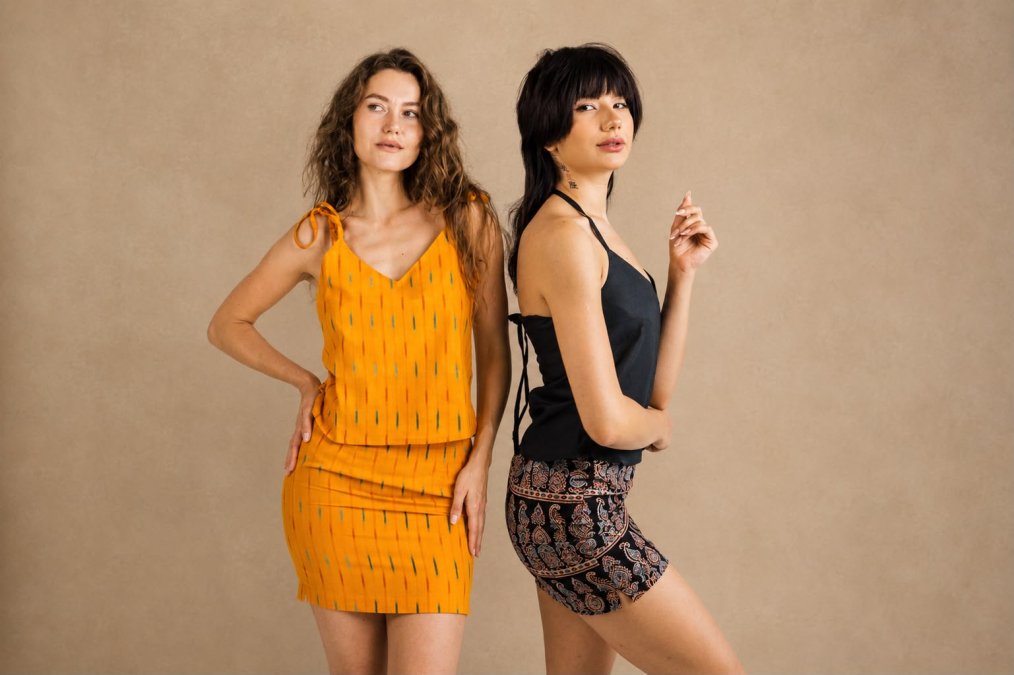
A printed wide-leg trouser is the easiest entry point for most people.
For something closer to the face, a printed dress with a solid layer over it keeps the pattern contained. The Strap Dress in indigo has a V neck and adjustable straps, and it layers cleanly under an open shirt when you want more coverage for the office.

- Keep shoes plain and dark for meetings
- Match your bag to a color already in the print
- Add one metal accent, then stop
Work to Evening Outfit Styling: One Look, Two Settings
The difference between a work outfit and an evening outfit is almost never the clothing. It is the accessories, the layer, and the shoe. Change two of those three and the same printed piece reads completely differently.
Here is the mechanism. A printed piece has a fixed visual weight. What changes is how much structure you put around it. Structure reads as professional. Ease reads as evening. You are not switching outfits. You are switching the frame.
The Three Swaps That Do All the Work
| Swap | Work version | Evening version | What changes visually |
|---|---|---|---|
| Layer | Structured blazer or open shirt | Nothing, or a soft knit over the shoulders | Adds or removes shoulder line |
| Shoe | Closed toe, low heel, dark | Open toe, heel, or a lighter tone | Changes the vertical line of the leg |
| Bag | Structured tote or satchel | Small shoulder bag or clutch | Shrinks the silhouette's footprint |
Pick two. You rarely need all three. A blazer plus a shoe swap is usually enough. A bag plus a shoe swap works when the printed piece is already tailored.
Why Fabric Weight Decides Whether This Works
A work-to-evening piece has to hold its shape without a blazer doing the work for it. That comes down to fabric weight and drape.
- A mid-weight cotton with body keeps a wide-leg silhouette clean when you remove the layer. It reads intentional on its own.
- A light, fluid fabric collapses without structure around it, so the evening version looks like the work version with the blazer missing.
- A stiff, heavy fabric holds the office look but can feel formal after hours, which limits the swap.
Most practitioners find that mid-weight cotton and cotton-linen blends sit in the sweet spot: enough body to stand alone, enough drape to soften when you drop the layer.
Our blue shirt is cut with relaxed tailoring and a softly structured shape, so it works buttoned with tailored trousers at 9 a.m. and open over a tank at 7 p.m.
The Girl Math of One Piece, Two Settings
This is where the math gets honest. A piece that works in two settings is not one purchase. It is two, and you only paid for one.
Run it this way.
That is the real version of girl math: not a story you tell yourself to justify a purchase, but a way of counting what a garment actually costs you per wear.
Styling instead of buying a look as-is is what moves that number.
This is the whole idea behind between two wardrobes: one set of pieces that does not need a separate work version and evening version, because the styling does the switching for you.
Styling vs. Buying: The Girl Math of a Versatile Wardrobe
No competitor in this space talks about the cost-per-wear math of a printed piece, and that is the gap worth claiming. The question is not whether a printed garment is worth buying. It is whether you are buying a garment or buying a look.
Buying a Look vs. Owning a Formula
Buying a look as-is means the outfit only exists in the form you saw it. One top, one bottom, one shoe, one bag, one setting. The moment you change any of those, the look stops working.
Styling means you own the formula. You know which solid anchors the print, which scale contrast holds, and which two accessories flip it from desk to dinner. The garment stays. The formula travels.
That distinction is what separates a piece you wear twice from a piece you wear weekly.
Running the Math Honestly
Girl math gets used as a joke about justifying spending.
The calculation is simple. Take what you paid, divide it by the number of times you realistically wear it in a year. That is your cost per wear.
Here is the part most people skip. A versatile piece is not one purchase. It is several, because it replaces outfits you would otherwise have to buy separately.
- A printed trouser that works with a white shirt, a black cami, and a fine knit in winter is doing the job of three separate bottoms.
- A printed shirt that works buttoned under a blazer and open over a tank is doing the job of two tops.
- A printed dress that layers under an open shirt for the office and stands alone after hours is doing the job of two dresses.
Count the outfits, not the items. That is the honest math.
Why Styling Beats Buying a Look
The difference you can make by styling instead of purchasing a look as-is is not small. It is the difference between a closet that produces outfits and a closet that stores them.
Styling a piece you already own costs nothing. Buying a new look costs everything, and it only works in the form you bought it.
That is why the pieces worth owning are the ones designed to be styled, not the ones designed to be worn one way.
Our pieces are designed for exactly this. They mix with what you already own rather than demanding a whole new wardrobe around them. That is the between two wardrobes idea in practice: not two closets, not two budgets, just one set of pieces and a formula that moves them from work to after hours with a change of accessories.
Conclusion
The hard part is not finding printed textiles. It is trusting that they belong in a professional wardrobe at all, and that trust only comes from wearing them a few times.
Noble Misfit exists for the people who are done choosing between two wardrobes. Our apparel is hand-printed using traditional block methods, made in India and designed in Toronto, and built to be worn daily rather than saved for occasions.
Shop now and find the piece that moves from your desk to your evening without missing a step.
Frequently Asked Questions
How do you wear printed clothes to work without looking too casual?
Choose one printed piece as your focal point, then keep everything else solid and structured. Wide leg trousers in a hand printed textile paired with a plain white or navy shirt reads polished because the silhouette is clean and the fabric has weight. Avoid pairing prints with distressed denim or athletic shoes. Instead, try loafers, a blazer, or a tucked-in button-down. The print adds personality; the tailoring keeps it professional.
Can you wear bold prints in a professional setting?
Yes, when the print is balanced by neutral or tonal pieces. A hand printed textile with a repeating motif in two or three colours works well because the pattern has rhythm rather than chaos. Pair bold printed trousers with a solid shirt in a shade pulled from the print itself. This creates visual balance without competing elements. The key is letting one piece lead while the rest of the outfit supports it.
How can you style one outfit for work and after hours?
Start with a piece that works in both settings, like a hand printed strap dress or wide leg trousers. For work, layer a structured shirt or blazer over it and keep accessories minimal. After hours, remove the layer, swap flats for sandals or heels, and add a belt or statement earrings. The outfit stays the same; only the accessories and layering shift. This approach means you style one look instead of buying two.
What accessories make a printed outfit look more professional?
Structured accessories anchor a print. A leather belt at the waist defines the silhouette. Simple gold or silver earrings add polish without competing with the pattern. A leather tote or structured shoulder bag signals office readiness. Avoid busy jewellery or scarves that introduce a second pattern. When the print is the statement, accessories should frame it, not fight it. Neutral leather in tan, black, or navy works with most hand printed textiles.


