


Authentic Indian Hand-Printed Textiles Online
Table of Contents
- Why Authentic Indian Hand-Printed Textiles Are Rare Online
- Contemporary Indian Fashion for Daily Wear: Moving Beyond Special Occasions
- Traditional Indian Textile Craftsmanship and Hand-Block Printing Methods
- Frequently Asked Questions
Last Updated: September 30, 2026
Why Authentic Indian Hand-Printed Textiles Are Rare Online
Finding authentic Indian hand-printed textiles online is genuinely difficult because most retailers offer digitally printed fabrics on synthetic blends instead. Hand-block printing requires months of artisan training and days of labor per garment, with cloth passing through repeated rounds of resist paste, dyeing, and washing, one color at a time. According to textile heritage research from the Crafts Council, authentic hand-block printing represents less than 2% of the global textile market, yet demand has exploded, leaving a gap most retailers fill with shortcuts. The lack of such brands offering genuine hand-printed pieces means consumers rarely encounter the real thing.
The concept of "between two wardrobes" addresses this gap, Noble Misfit integrates authentic hand-printed textiles into contemporary silhouettes designed to work with your existing professional wardrobe, filling the space most retailers ignore.
Contemporary Indian Fashion for Daily Wear: Moving Beyond Special Occasions
Indian textiles have traditionally been occasion-wear for weddings and festivals, separate from professional life. Contemporary Indian fashion means cutting textile traditions into shapes that work with professional environments, the Ajrakh Women's Full Sleeve Shirt in Red ($129.00) is structured like a formal shirt but printed in one of the most labor-intensive textile traditions, bridging both worlds.

Traditional Indian Textile Craftsmanship and Hand-Block Printing Methods
Hand-block printing uses one carved wooden block per color, with the artisan applying resist paste, dyeing, and washing repeatedly, a single piece passes through 8-12 rounds before finishing.
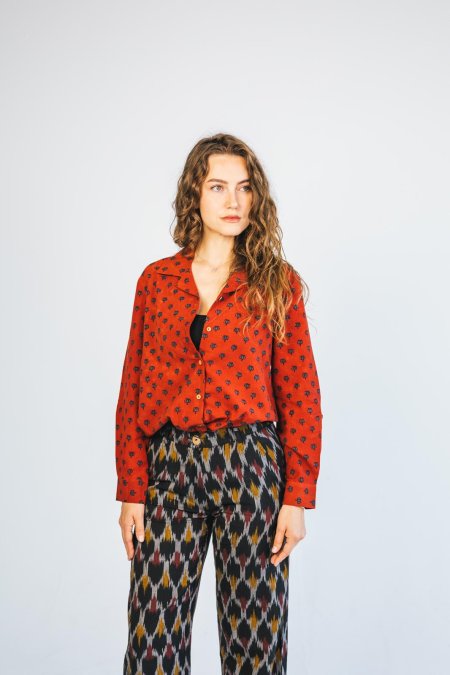
Sanganeri printing builds patterns one block at a time, each color requiring a separate pass; the Sanganeri Crop Shirt in Green and Yellow ($129.00) shows hand-placed variation. Jamdani weaving adds motifs by hand during weaving, thread by thread. The shortage of authentic hand-printed textiles online stems from labor reality: limited trained artisans mean supply cannot scale without compromising craft.
If a retailer claims hand-block printing but offers unlimited inventory or extremely fast shipping, the piece likely isn't hand-printed. Authentic hand-block printing is inherently limited and requires time. Noble Misfit acknowledges this constraint with limited runs and no restocks; pieces like the Ajrakh Fitted Mini Skirt in Black ($119.00) carry variations that prove authenticity.
Ajrakh Fitted Mini Skirt – Black →

| Textile Tradition | Craft Method | Labor Intensity |
|---|---|---|
| Ajrakh | Hand-block printed, repeated dyeing rounds | Highest |
| Sanganeri | Hand-block printed, floral motifs | High |
| Digital Print (synthetic) | Machine-applied to finished cloth | Low |
Noble Misfit fills the gap most retailers ignore by designing everyday clothing around genuine Indian hand-printed textiles, respecting both craft and the wearer's actual life. Shop Now
Frequently Asked Questions
What defines authentic Indian hand-printed textiles?
Authentic hand-printed textiles are created using carved wooden blocks pressed onto fabric by hand, with each colour applied in separate passes. The process involves resist paste, natural dyeing, and washing between stages. Unlike digital printing, hand-printed pieces show slight offsets where blocks meet, evidence of the artisan's work. Ajrakh and Sanganeri are labour-intensive traditions where depth of colour develops through repeated dyeing rounds, not single applications.
How can I distinguish between mass-produced prints and authentic hand-printed Indian textiles?
Look for irregularities: authentic hand-printed textiles show slight variations in colour intensity, motif spacing, and block placement across the cloth. Mass-produced prints appear perfectly uniform. Hand-printed pieces display visible offsets where one block met the next, the clearest proof of handwork. Check the fabric content: authentic pieces use 100% natural cotton that breathes and creases honestly, not synthetic blends. Ask about the dyeing process; authentic textiles use natural dyes applied over multiple rounds, creating depth impossible to achieve digitally.
Why is it difficult to find contemporary clothing with authentic Indian hand-printed textiles?
Most online retailers prioritize speed and scale, relying on digital printing or mass-produced reproductions. Hand-block printing demands weeks of labour per garment, artisans work through repeated resist-paste applications, dyeing, and washing cycles. This makes authentic pieces limited-run and expensive to produce. Few brands invest in direct relationships with artisan communities or commit to the slow, intentional process. Most fast-fashion alternatives use synthetic fabrics with printed approximations, not the authentic textile heritage that defines true craftsmanship.
Can I really wear hand-printed Indian textiles in my everyday professional wardrobe, or do they only work for special occasions?
Hand-printed pieces designed as contemporary clothing blend seamlessly into daily wardrobes. Ajrakh and Sanganeri garments in neutral grounds (black, rust, indigo) pair with tailored trousers, blazers, and jeans. A fitted Ajrakh mini skirt works with a black knit and ankle boots in autumn, or with opaque tights and tall boots in winter. Jamdani A-line skirts transition from office to evening without changing. The key is choosing pieces with versatile silhouettes and colour palettes, contemporary cuts in hand-printed cotton work as everyday clothing, not ceremonial wear.


