


Ethical Artisan Clothing Return Policy Guide: 2026
Table of Contents
- Why Artisan Return Policies Need a Different Approach
- What the Consumer Protection Act Return Policy Means for Online Clothing
- How to Write a Clothing Refund Policy That Customers Trust
- Sustainable Fashion Return Practices for Small-Batch Makers
- Handling Defective or Damaged Artisan Goods
- Restocking Fees, Exchanges, and Store Credit: Getting the Balance Right
- Frequently Asked Questions
Last Updated: September 26, 2026
Why Artisan Return Policies Need a Different Approach
An ethical artisan clothing return policy guide has to solve a problem mass-market retailers never face: every garment is one of a small run, often printed by hand, and an artisan clothing return cannot simply go back on a warehouse shelf. At Noble Misfit, we build our pieces around traditional Indian textiles and hand-printed methods, so a return is never neutral, it costs the maker time, materials, and sometimes the piece itself.
What the Consumer Protection Act Return Policy Means for Online Clothing
There is no single federal rule in Canada forcing a retailer to accept a change-of-mind return (Refund and exchange). Return rights for online clothing come from provincial consumer protection legislation, federal privacy and e-commerce rules, and the brand's own published policy, the combination most people mean when they search for a consumer protection act return policy.
Your Rights When Buying Hand-Printed Garments Online
Consumer protection legislation is provincial law setting baseline rules for how businesses must treat buyers, including disclosure, cancellation rights, and remedies for faulty goods. A buyer's strongest legal footing comes from three situations:
- The item arrived damaged, defective, or materially different from its description
- The seller failed to disclose a material fact before purchase
- The item was never delivered, or arrived late under a stated delivery guarantee
When a Brand Can Legally Refuse a Return
A brand can refuse a return when the item falls outside its published eligibility criteria, garments worn, washed, altered, or with swing tags removed, or items returned after the stated window.
How to Write a Clothing Refund Policy That Customers Trust
A trustworthy clothing refund policy states the return window, condition requirements, who pays return shipping, and refund timing in plain language on one page. Vague policies cost sales before they ever cost a return.
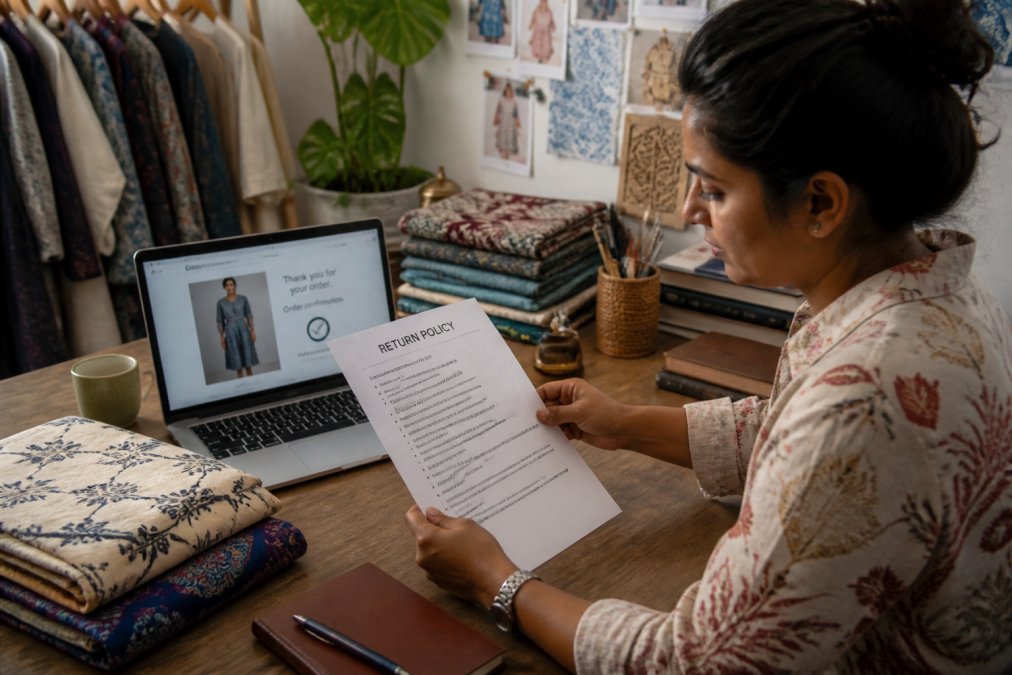
The 8 Elements Every Return Policy Must State Clearly
- Return window duration, the number of days from the invoice date or delivery date, and whether the clock starts at purchase or at receipt
- Eligibility criteria, what counts as returnable, including whether the item must be unworn, unwashed, and in original condition
- Original packaging requirements, whether the garment must include swing tags, the original polybag, or the branded box
- Proof of purchase, order confirmation, order number, or receipt
- How to initiate a return request, the return portal, email address, or form, and whether a return authorization is required first
- Return shipping cost and responsibility, who pays, and which carrier drop-off options are accepted
- Refund processing timelines, how many business days after item inspection the refund is issued
- Refund method, original payment method, store credit, or exchange, and whether a restocking fee applies
Step-by-Step: Drafting Your Policy in 2026
- Audit your actual costs. Calculate return shipping, inspection time, cleaning, and resale value before writing a word, this sets your restocking fee decision.
- Draft the eight elements as plain sentences. No sub-clauses; rewrite comma-spliced exceptions as bullets.
- Separate change-of-mind returns from defect returns. Different windows, shipping responsibility, and outcomes.
- Add a returns portal or one dedicated email address. A single entry point removes friction and creates an audit trail.
- Publish it where buyers see it before checkout. Link it from every product page, not just the footer.
- Test it on a real order. Run one return end to end and time it.
- Review every six months. Carrier rates, packaging costs, and provincial requirements shift.
Sustainable Fashion Return Practices for Small-Batch Makers
Sustainable fashion return practices start with a hard truth: a returned hand-printed garment often cannot be resold as new. Once it has left your studio, been worn, and come back, packaging integrity is gone and the piece may need re-pressing, re-tagging, or cannot be listed at full value. The goal is not to discourage returns but to reduce unnecessary ones while keeping the process fair.
What Reverse Logistics Actually Costs, Environmentally
Reverse logistics is the process of moving goods backward through the supply chain, from customer back to seller. For a small-batch maker, every reverse logistics event carries a fixed cost that does not shrink with order volume, plus an environmental cost most policy pages never mention.
- Fit guidance over fit returns. Detailed measurements, model sizing notes, and a fit quiz cut the largest single cause of clothing returns.
- Photograph garments on multiple body types. Buyers return what they cannot picture on themselves.
- Offer exchanges before refunds. An exchange keeps the sale and often costs less than a refund plus restocking.
- Set a realistic window. A 14-day window reduces pieces that come back worn after a full season.
- Batch your return processing. Set two processing days per week to consolidate inspection, re-pressing, and re-tagging, cutting handling energy per item.
Packaging Reuse: A Protocol, Not a Suggestion
Reusable and recyclable packaging is the most direct lever a small maker has. If your mailer survives a second trip, a returned garment comes back in the same packaging, eliminating one new mailer per return. But "reuse the packaging" as a vague instruction rarely works, customers need a protocol.
A workable reuse protocol looks like this:
- Ship in a durable, resealable mailer, compostable or recycled-content with a second adhesive strip.
- Include a return card telling the customer how to reseal the mailer and where to drop it off.
- Ask for swing tags to stay attached on change-of-mind returns, so the piece can be re-listed without re-tagging.
- Instruct customers to fold, not stuff. A garment folded along its original crease lines needs less re-pressing.
- State what you cannot accept in reused packaging, a mailer that is torn, water-damaged, or used to ship something else.
Ask customers to return items in the original packaging where it is still intact, and give them a one-line protocol for how. It is a small instruction that cuts packaging waste on every return and costs you nothing to add to your policy.
The Trade-Off You Have to Name
A stricter packaging-reuse requirement can raise the refusal rate, because customers who discarded the mailer feel they failed a rule. Make reuse the preferred path, not a condition of eligibility: reward it, for example, by covering return shipping on items sent back in original packaging, rather than penalizing customers who cannot.
Handling Defective or Damaged Artisan Goods
Defective or damaged artisan goods require a different process from change-of-mind returns, and treating them the same is where most small brands damage their reputation. When a hand-printed piece arrives with a flaw, the customer is reporting a quality failure, and the brand owns the full cost.
The process that works:
- Ask for photos first. A photo of the flaw taken on arrival resolves most disputes in one exchange.
- Skip the restocking fee entirely. A defect is not the customer's fault, and charging for it reads as punitive.
- Cover return shipping both ways. The brand pays to bring a defective item back and to send a replacement.
- Offer a replacement before a refund. For a small-batch piece, a replacement preserves the sale and the relationship.
- Log every defect. Patterns point to a specific artisan batch, print run, or fabric lot, quality assurance data.
Restocking Fees, Exchanges, and Store Credit: Getting the Balance Right
Restocking fees are the most misunderstood tool in a small-batch return policy. A restocking fee is deducted from a refund to cover processing a returned item back into sellable inventory. For a maker producing in runs of twenty, that cost is real and unavoidable, and the most common source of customer friction in artisan returns.
Why Small-Batch Makers Charge Restocking Fees
When a mass-market retailer takes back a garment, it goes onto a shelf or into liquidation, and the marginal cost is a few dollars of labor. When an artisan maker takes back a hand-printed piece, it must be inspected for wear, re-pressed, re-tagged, and re-photographed before relisting, and in a run of twenty, there is no warehouse of identical stock to absorb the loss.
How to Disclose a Restocking Fee Without Losing the Sale
Disclosure is where most policies fail. A restocking fee buried in a footer link is functionally a hidden fee, and hidden fees turn returns into disputes.
A disclosure that works has four parts:
- State the fee as a percentage, not a vague "processing charge." "A 12% restocking fee applies to change-of-mind returns" is clear; "a restocking fee may apply" is not.
- Name the exceptions in the same sentence. "No restocking fee applies to defective, damaged, or incorrectly shipped items."
- Show the fee at checkout. A one-line note near the payment button removes the surprise.
- Repeat it in the order confirmation email. This is the document customers keep.
A restocking fee that is not disclosed before purchase is not enforceable in most provincial consumer protection frameworks, and it will not survive a credit card chargeback. Disclose it at checkout or do not charge it.
Exchanges and Store Credit: The Better Defaults
Here is how the three options compare in practice:
| Option | Best For | Cost to Customer | Cost to Maker |
|---|---|---|---|
| Full refund | Defective goods, first-time buyers | None | Highest |
| Exchange | Sizing and fit issues | Return shipping only | Lowest |
| Store credit | Change-of-mind returns | None | Low |
| Refund with restocking fee | High-value, low-volume pieces | Fee deducted | Medium |
Exchanges deserve more emphasis than most policies give them. An exchange keeps the revenue, avoids the refund timeline, and usually resolves the actual problem, fit rather than dissatisfaction. For a small-batch maker, it is also the only outcome that keeps a one-of-twenty piece in circulation rather than in a returns bin.
Small-batch makers producing limited runs who need to protect margin on change-of-mind returns without penalizing buyers for genuine quality issues. The right default is exchange first, store credit second, refund with a disclosed restocking fee third, and full refund always for defects.
The One Rule That Overrides Everything
Whatever fee structure you choose, the defect exception is absolute. A hand-printed piece arriving with a printing flaw, a seam failure, or a color materially different from the product photo is a quality failure, not a change of mind. Charging a restocking fee on a defective item is the fastest way for a small brand to lose the trust it spent years building, and in most provincial consumer protection frameworks, it is not defensible anyway.
Frequently Asked Questions
Can you return an item after opening it?
For artisan clothing, opening the package is fine. What matters is the condition of the garment itself. Most ethical brands accept returns if the item is unworn, unwashed, and still has its swing tags attached. Try the piece on, check the fit, but keep the tags on until you decide. Once tags are removed or the fabric shows signs of wear, the return eligibility typically ends.
Do I have to pay for return shipping?
It depends on why you are exchanging the item. For fit or preference exchanges, many small-batch makers ask the customer to pay. Check the exchange portal or your order confirmation for the specific terms before you ship anything back.
Are there specific consumer protection laws in Canada regarding returns for online purchases?
Yes. Provincial consumer protection legislation sets baseline rules for online purchases, including the right to clear information before buying. However, these laws do not mandate a universal return window for change-of-mind returns. The consumer protection act return policy requirements focus on disclosure, not forcing brands to accept all returns. Always read the brand's stated policy before ordering, since that is the contract you agree to at checkout.
How do return policies impact the carbon footprint of ethical fashion brands?
Every exchange adds shipping miles and often results in packaging waste. For small-batch makers, the environmental impact of exchanges is proportionally larger because production volumes are lower. Sustainable fashion exchange practices like consolidated shipping, packaging reuse programs, and clear sizing guides reduce the number of exchanges. Some brands offer store credit to keep garments in circulation rather than in reverse logistics.
Can artisan brands legally refuse returns on hand-printed or custom textiles?
Brands can set limits on returns for custom or made-to-order items if they state this clearly before purchase. Hand-printed textiles with natural variations in color or pattern are not considered defective, so a brand may refuse a return for those reasons. However, if the item arrives damaged or significantly different from its description, consumer rights still apply and the brand must offer a remedy.
What information must be clearly stated in an online clothing return policy?
A complete policy should state the exchange window (counted from the delivery date or invoice date), the condition requirements (unworn, unwashed, original packaging, swing tags attached), who pays return shipping, whether exchanges or store credit are offered, and any restocking fee. It should also explain how to initiate an exchange through the return portal and what proof of purchase is needed.


