


Authentic Artisan Clothing for Canadian Buyers: 2026 Guide
Table of Contents
- Where Canadian Buyers Find Authentic Artisan Clothing
- How to Identify Authentic Artisan Clothing Before You Buy
- What Hand-Printed Textile Clothing Actually Costs and Why
- The Friction of Buying From Stores Based in India or the USA
- International Returns for Clothing: What to Check First
- Versatile Everyday Ethnic Wear That Earns Its Place
- Between Two Wardrobes: Why Representation Matters in Fashion
- Frequently Asked Questions
Last Updated: October 12, 2026
Where Canadian Buyers Find Authentic Artisan Clothing
Authentic artisan clothing for Canadian buyers is apparel made in small batches by hand, where the maker's technique is visible in the finished piece rather than hidden behind a factory finish.
Most people start in the same three places. Instagram, where a maker's feed shows the printing table and the drying yard. Etsy and small-batch shopfronts, where you can message the seller directly.
The problem is not finding artisan clothing. It is finding it on a store that ships from another country, prices in another currency, and treats your return as an international shipment.
Below, we break down how to verify a piece before you buy, what hand-printed textile clothing actually costs, and why we built Noble Misfit to remove the friction between you and the craft.
How to Identify Authentic Artisan Clothing Before You Buy
Authentic artisan clothing shows evidence of the hand that made it. Machine printing repeats perfectly. Hand block printing does not, and that is the point.
Two checks settle most doubts: the print itself, and the label inside the collar.
Check the print for hand-block offsets
Look for small misalignments where one block met the next. On a dense print, those tiny offsets are the clearest proof a person placed the block, pressed it, and lifted it again. A pattern that lines up with pixel-perfect precision across a whole garment is usually digital.
Colour is the second tell. Hand block printing builds depth over repeated rounds of dyeing and washing, one colour at a time. The result reads uneven in a good way. Flat, uniform colour across a large panel points to a single pass.
Read the fabric label, not the marketing copy
The label tells you more than the product page. Look for a named fibre, like 100% pure cotton, and a named craft, like Ajrakh or Sanganeri. "Heritage-inspired" tells you nothing. "Hand block printed" tells you how the cloth was made.
Competition Bureau guidance on textile labelling and false claims is worth knowing if a brand's claims feel inflated. Canadian labelling rules require accurate fibre content and origin information, and a seller that is vague about either is usually vague for a reason.
What Hand-Printed Textile Clothing Actually Costs and Why
Hand-printed textile clothing costs more because the cloth passes through many hands and many stages before it becomes a shirt.
That is why a hand-printed cotton shirt sits in a different range than a mass-produced one. You are paying for time, not for a logo.
Our own pieces reflect that. The Ajrakh Women's Full Sleeve Shirt in Red is $129.00. The Men's Full-Sleeve Shirt in Brown Sanganeri and Ajrakh is $159.00, and the Ajrakh Men's Camp Collar Shirt in Black is $149.00. Each is a limited run with no restocks.


| What you are paying for | Mass-produced print | Hand block print |
|---|---|---|
| Printing method | Digital, single pass | Hand-blocked, colour by colour |
| Colour depth | Flat and uniform | Built over repeated dye rounds |
| Repeatability | Identical across units | Small offsets, unique per piece |
| Run size | Continuous | Limited, often no restock |
| Fibre | Often synthetic blends | Natural cotton |
The real cost drivers behind a hand-printed shirt
Four things push the price above a fast-fashion equivalent, and none of them are marketing:
- Labour hours per metre. A digital printer runs a whole roll in minutes. A hand block printer works panel by panel, and a complex Ajrakh design can take days of printing, drying, and washing before the cloth is ready to cut.
- Natural dyes and repeated washing. Each colour round requires dyeing, drying, and washing. That is water, time, and handling that a single-pass print never incurs.
- Small run sizes. A limited run spreads the setup cost across fewer units. A continuous production line spreads it across thousands.
- Natural fibre. Pure cotton costs more than a synthetic blend, and it behaves differently over years of wear.
How to judge value, not just price
A common mistake is comparing a hand-printed shirt to a fast-fashion equivalent on price alone. They are not the same product, and the gap in wear is wider than the gap in cost.
A more useful comparison is cost per wear. A mass-produced print that fades, pills, or loses shape after a season gets replaced. Most people who buy artisan clothing find the value shows up in the third or fourth year, not the first.
The Friction of Buying From Stores Based in India or the USA
Here is where most Canadian buyers hit a wall. You find the perfect piece, and then you discover the store ships from India or the United States. Suddenly the price you saw is not the price you pay.
Three things change at checkout:
- Duty and import charges. Cross-border parcels can attract customs handling fees and taxes on delivery, and the amount is not always clear up front.
- Currency. You are converting, and the rate moves between the day you order and the day it ships.
- Returns. Sending a garment back to another country is slow and often costs more than the item is worth.
Then there is sizing. Handmade pieces run differently, and if you cannot try before you buy, a bad fit becomes an expensive lesson.
Ajrakh Women's Full Sleeve Shirt - Red →
International Returns for Clothing: What to Check First
International returns for clothing are the single biggest reason people abandon a cart. The piece is beautiful, the fit is uncertain, and the return path is unclear. Competitors rarely explain the mechanics, so here is what actually happens when a parcel crosses a border and comes back.
The four things to confirm before you order
- Return window. How many days from delivery, and does the clock start on shipping or on receipt? A 14-day window that starts on shipping can expire before the parcel reaches you.
- Who pays return postage. The seller, or you? On cross-border orders, return postage often costs more than the garment itself.
- Duty recovery. If you paid import charges on delivery, do you get them back on a return? This is the step most buyers miss.
- Exchange versus refund. Some sellers only offer store credit on international orders, which locks your money into a store you may not want to use again.
How duty recovery actually works
When a parcel enters the country, the carrier or the border agency assesses duties and taxes. If you later return the goods, those charges are not automatically refunded. You typically need to file a claim with the border agency, provide proof of return, and wait for processing. Canada Border Services Agency guidance on returning goods and duty refunds explains the process. The key point: recovery is possible, but it is paperwork you have to initiate, and many buyers never do.
Sizing is the hidden return driver
Handmade pieces run differently from mass-produced ones. A hand-block-printed shirt cut in small batches may vary slightly from unit to unit, and a size chart built for factory-standardized garments will not always predict the fit. When you cannot try before you buy, a bad fit becomes an expensive lesson that no return policy fully solves.
How to avoid the return problem entirely
This is the friction we set out to remove. Noble Misfit designs in Toronto and crafts in India, so the craft stays authentic while the buying experience stays local. You are not chasing a parcel across three borders to get a shirt that fits. The sizing guidance reflects how the pieces actually run, the return path is domestic, and the currency is the one you already use.
That is the difference between buying artisan clothing and importing it. The craft can cross borders. The friction should not have to.
Versatile Everyday Ethnic Wear That Earns Its Place
Versatile everyday ethnic wear is clothing you can wear on a Tuesday, not just to a wedding. That distinction matters more than any trend.
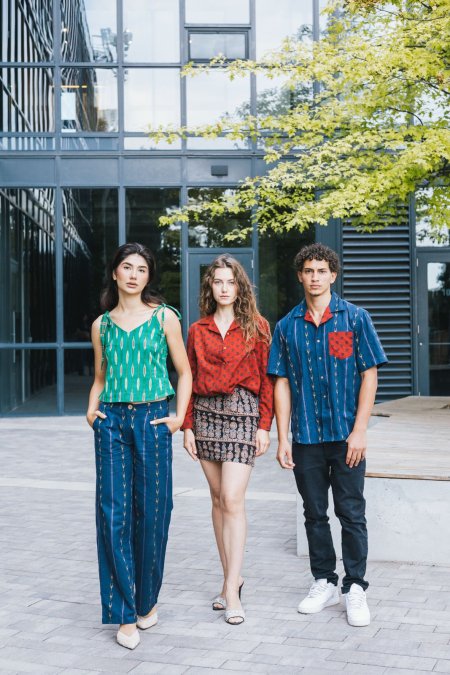
We design every piece to mix with the wardrobe you already own. A hand-printed shirt is not a costume. It is a shirt.
Dressing one piece three ways
Take the Ajrakh Women's Full Sleeve Shirt in Red. It pairs three ways without changing its nature:
- Work: buttoned with tailored trousers, sleeves down, for a formal shirt that carries a print.
- Weekend: open over a black cami with jeans, letting the print do the talking.
- Evening: tucked into a black skirt or layered under a knit, with boots.
That is the test we apply to everything. If a piece only works for one occasion, it does not earn its place.
Between Two Wardrobes: Why Representation Matters in Fashion
Between two wardrobes is the space so many of us live in.
We understand this because we live it. We understand Canadian culture, and we understand the immigrant need for representation in fashion.
The old model asked you to choose. Wear the heritage piece to the wedding and put it away.
Second-generation professionals, bridesmaids facing three weddings in a season, anyone who wants their clothes to say something without shouting it: the answer is not more outfits.
The real challenge is not finding beautiful artisan clothing.
Frequently Asked Questions
How can I tell whether clothing is genuinely artisan-made?
Look at the print itself. Hand-block printing leaves small offsets where one block met the next, and slight variations in colour depth because dye is applied in repeated passes rather than one pass. A perfectly repeating, edge-to-edge pattern with identical colour across every unit usually means digital printing on synthetic fabric. Check the fibre label too: pure cotton or linen behaves differently from polyester blends, and artisan pieces are normally made in small runs rather than restocked endlessly.
What should I check before ordering clothing from an international store?
Confirm three things before you pay: who handles the return and where it ships back to, whether duties and taxes are collected at checkout or billed on delivery, and whether the size chart reflects garment measurements or body measurements. Handmade pieces often run large, so a brand that tells you to size down is giving you useful information. Also check whether the brand states where the garment was made and where it was designed, since those are often different countries.
How do international returns for clothing work when buying small-batch pieces?
Most small-batch makers accept returns within a set window, but you usually pay the return shipping and any duties already paid are rarely refunded. Before ordering, note the return address, the window in days, and whether the item must be unworn with tags attached. If the piece is made to order or marked as a limited run, returns are sometimes excluded, so read that line carefully. Keep your tracking number and photograph the parcel before sending it back.
Can artisan clothing work for everyday wear, not just special occasions?
Yes, if the cut is designed for it. A hand-printed cotton shirt worn buttoned with tailored trousers reads as office wear; worn open over a plain tee with jeans it reads as weekend. The same garment covers both because the print carries the interest and the silhouette stays simple. Look for pieces that pair with what you already own, and check the care instructions, since natural cotton and linen generally wash well and soften with use.


